****Call for English Submissions: Journal of Iranian Studies****

The Journal of Iranian Studies is committed to fostering international collaboration and advancing scholarly excellence. We invite researchers and specialists in Iranian studies and related fields worldwide to contribute to our journal.

We welcome original, peer-reviewed research articles in English across all domains of Iranian studies (both theoretical and applied) for consideration and publication.

Iranian Studies

The Iranian Studies is a scientific-research journal affiliated with the Faculty of Literature and Humanities at the University of Tehran. Its mission is to expand and elevate knowledge in the fields of Iranian history, culture, language, literature, and civilization. Published quarterly with up to four issues per year, the journal provides a platform for disseminating original and innovative research across various domains of Iranian studies.Articles in this journal analyze and explore diverse dimensions of the “Cultural Iran,” including: History and Archaeology-Persian Literature and Linguistics-Ancient Languages-Philosophy and Mysticism-Religion-Art-Anthropology and Folklore-Subcultures-Handicrafts-Local Customs and Traditions.The journal was initially published under the supervision of the late Dr. Mozaffar Bakhtiyar and the editorship of the late Dr. Iraj Afshar, in collaboration with a group of distinguished Iranian and international scholars. Notable Iranian contributors included Dr. Haeri, Dr. Zaryab Khoyi, Dr. Sotoudeh, Dr. Shahidi, Dr. Navabi, Dr. Farmanfarmaian, Dr. Moḥaqqeq, Dr. Minovi, and Dr. Negahban. International scholars such as Dr. Nasr, Dr. Roemer, Dr. Arzi, Dr. Scarceia, Dr. Boyle, Dr. Savory, among others, also enriched its content.Subsequently, in line with efforts by the University of Tehran’s publication authorities to enhance quality and specialize its journals, the Faculty of Literature Journal was divided into several specialized publications. One of these is the Iranian Studies Research Quarterly, which continues its mission independently. In accordance with Letter No. 100159 dated September 6, 2011, from the Commission for Scientific Journals of the Ministry of Science, Research, and Technology, this journal holds a scientific-research ranking. The Iranian Studies Research Quarterly aims to; Introduce the academic community to the latest research achievements in Iranian studies; Contribute to the preservation and understanding of Iran’s cultural heritage; Provide a specialized platform for scholarly exchange. Relying on a rich scientific and historical foundation, the journal consistently welcomes credible and innovative research articles in all fields related to Iranian studies.


Journal Profile

  • Journal Title: Iranian Studies

  • Owner: Faculty of Literature and Humanities, University of Tehran

  • Publisher: University of Tehran Press

  • English Title: Iranian Studies

  • Scientific Category: Humanities

  • Sub-Categories: History, Research, Periodicals, Culture & Art

  • Scientific Rank: Scientific-Research

  • Date of Accreditation: 15/06/1390

  • Peer Review Type: Double-Blind, Anonymous, and Confidential

  • Journal access status: Open Access
  • Average Initial Review Time: Approximately 3 weeks

  • Average Peer-Review & Acceptance Timeline: 3–4 months (minimum two reviewers)

  • Acceptance Rate: 14%

  • Publication Frequency: Biannual (Every two months)

  • Language: Persian (with abstracts and references in both English and Persian)

  • Publication Type: Electronic

  • Access Type: Open Access (Full Text)

  • Print ISSN: 0643-2252

  • Electronic ISSN: 4601-2676

  • Citation Style: APA

  • Phone: +98-21-61112999

  • Email: jiranic@ut.ac.ir

  • Website: https://jis.ut.ac.ir/

  • Article Review Fee: Yes

  • Final Acceptance & Publication Fee: Yes

Copyright Policy

The journal adheres to international Creative Commons copyright laws. Copyright of articles remains with the authors, who retain ownership of their work.

Publication Ethics

Iranian Studies respects publication ethics and follows the guidelines, principles, and regulations of the Committee on Publication Ethics (COPE), as well as Iran’s executive bylaws for preventing and confronting scientific misconduct.

Plagiarism Policy

Based on an agreement with SinaWeb, all submitted manuscripts are screened for plagiarism using similarity-checking software (HamtaYab, Samim Noor) before entering the peer-review process.

Important Notes for Authors

  • The journal charges a fee after peer review and before publication for accepted articles; however, republication of content with proper citation is free.

  • In accordance with the requirements of the Commission for Scientific Journals, authors are required to register and display a free ORCID iD and use an academic or institutional email for correspondence. Please obtain your ORCID iD and academic/organizational email before submitting your manuscript.

  • The corresponding author must be a faculty member of a university, research center, or institute. Doctoral or Master's students cannot serve as the sole corresponding author; the corresponding author is determined by mutual agreement among all authors. Authors are responsible for ensuring the absence of plagiarism, data fabrication, and misuse of AI in their work.

Required Files & Forms

The following essential files must be submitted through the journal’s online submission system:

  1. Main Manuscript File (anonymous, without author names, following the journal’s template/format).

  2. Title Page File containing author details.

  3. Commitment Form (including the article title and full names of all authors, signed by all authors).

  4. Conflict of Interest & Authorship Contribution Form (signed by the corresponding author and uploaded with the manuscript).

Article Format

The final version of an accepted article must be prepared according to the journal’s template; otherwise, it will not be processed for publication.


Important Note on English Abstracts

For final accepted articles, authors must prepare, in addition to a short English abstract, an extended English abstract of 1000–1200 words, and include it in the manuscript following the provided template. This extended abstract must be submitted along with other required files via the journal’s submission system. AI tools may be used for proofreading, grammar checks, and text rewriting of the English abstract.

Fee Structure

The Iranian Studies journal charges 1,500,000 Rials for the initial review process. If the article is accepted, an additional 4,500,000 Rials will be charged for publication (total 6,000,000 Rials).

Upon notification from the journal’s office, this amount should be paid via the online payment portal available on the journal’s website. Alternatively, the payment can be made to the following account designated for the University of Tehran at the Central Bank:

  • Account Number: 4001070103006825

  • IBAN: IR830100004001070103006825

  • Deposit Reference ID: 314070174140107000000002002202

  • Account Name: Concentration of Special Funds of the University of Tehran

Please send a copy of the payment receipt to the journal's email. Online payment through the journal's website is the preferred method.

ISSN Record

The Role of Salaries and Religious Donations in Consolidating Achaemenid Political Power: A Documentary Analysis of the Persepolis Tablets

Pages 1-18

https://doi.org/10.22059/jis.2026.408992.1392

Mahshid Khoddami, Hossein Badamchi

Abstract The present study examines the multifaceted role of wages and religious offerings in consolidating and reinforcing political authority within the Achaemenid Empire, with particular emphasis on the ancient documentary evidence preserved in the Persepolis Fortification Tablets. The primary objective of this research is to provide a comprehensive analysis of the mechanisms through which ritual and economic resources were distributed among social, administrative, and religious groups, and to evaluate the impact of these practices on the legitimacy, stability, and durability of the imperial power structure. The research data consist of the extensive corpus of Persepolis Fortification Tablets, which have been meticulously examined and systematically coded using a rigorous documentary analysis methodology. The findings reveal that the system of payments, rations, and ritual allocations functioned not merely as an economic mechanism but also as a strategic instrument for strengthening the loyalty, cooperation, and compliance of court officials, priests, and local elites throughout the empire. Furthermore, a detailed geographical and structural analysis of these documents demonstrates a deliberate and clear correlation between the central authority in Persepolis and the distribution of wages in subordinate regions, reflecting a sophisticated approach to administrative control and political governance. The results highlight the critical role of religious offerings and state-administered wages as essential tools employed by the Achaemenids to legitimize their rule, stabilize social hierarchies, and maintain imperial cohesion. By providing new insights into the interplay between economic, ritual, and political dimensions, this study contributes to a deeper understanding of the organizational and ideological foundations of Achaemenid imperial power and offers a valuable perspective for reevaluating the empire’s economic and religious–political structures

Manichaeism and Its Zurvanian Roots: From Conceptual Interaction to Cosmological Opposition

Pages 19-46

https://doi.org/10.22059/jis.2026.411642.1405

ّFarshad Farshbaf Abrishami, Majidreza Rajabi, Mehrnaz Behroozi

Abstract As one of the most significant Gnostic movements of late antiquity, Manichaeism emerged from the cultural and religious context of Iran. One of the most debated issues in Manichaean studies concerns the extent and nature of this religion's indebtedness to Zurvanism, an influential current within Sasanian Zoroastrianism. Adopting a comparative approach, this study demonstrates that Manichaeism's encounter with Zurvanism transcended mere borrowing, evolving into conceptual interaction and ultimately cosmological opposition.The central question addresses the extent of Zurvanian elements in Manichaeism and how this conceptual engagement led to cosmological confrontation between the two systems. Employing a descriptive-analytical method, this research draws upon Manichaean texts (including the Kephalaia and hymns), Pahlavi sources (such as the Bundahishn and Ardā Wirāz Nāmag), and historical accounts.Findings indicate that while Manichaeans adopted the concept of "Zurvan" as the god of boundless time, they fundamentally transformed its function. In Zurvanism, Zurvan holds a primordial and exalted position; in Manichaeism, however, he becomes symbol of the material world and imprisoning time—synonymous with the dark hell. This conceptual shift reveals a profound cosmological opposition: Manichaeism regards the world and time as absolute evil from which liberation is sought, whereas Zurvanism attempts to explain the origin of evil within a framework tending toward monotheism.Thus, Manichaeism appropriated Zurvanian myths to construct a new adversary for the God of Light, redefining Zurvan as embodiment of darkness and captivity. This study contributes significantly to understanding pre-Islamic Iranian religious interactions and their divergent approaches to the fundamental problems of evil and time. 

Iconographical Analysis and Iconological Interpretation of the Snake and Eagle Motif in the Jiroft Civilization (3rd Millennium BC)

Pages 47-68

https://doi.org/10.22059/jis.2025.393018.1341

Esmaeil Sangari, Shaghayegh Taheri Bakhtiarvand

Abstract In January 2001, a common surge within the southeastern area of Kerman, Iran, uncovered an obscure culture in Jiroft. The surge revealed artifacts that each uncover a covered up corner of the obscure culture of the people of Jiroft within the third thousand years BC. In spite of the disclosure of an obscure composing framework in Jiroft culture, the pictures utilized on the artifacts of this culture are of evident significance. Distinctive human, plant, creature, structural, and human-animal images are apparent on these artifacts. To get it and studied the existing images, the as it were way out is to examined the iconographic and iconological themes of the themes and compare these themes with the neighboring civilizations of the culture. Iconographic consider makes it conceivable to get to the scholarly substance, myths, and stories related to the themes. In differentiate, iconological consider will lead to an understanding of the genuine foundation of the discovered motifs in terms of time and put within the center of the society in address. One of the foremost common images utilized in Jiroft vessels is the motif of the fight of the hawk and the wind. The predominance of this picture within the craftsmanship of the obscure culture of Jiroft certainly contains covered up concepts that the Jiroft craftsman tries. In the research, reference has been made to the analysis of the images of the eagle and the snake in religious and literary texts such as Bondahesh and Kalīla wa Dimna. On the other hand, through a comparative study, the explanation of the said icon in neighboring civilizations of the Jiroft in the third millennium BC has been pointed out. The show inquire about, based on library assets and descriptive-analytical strategies, serious to look at this not-so-well-known culture through the investigation and translation of the theme in address

Proposal for Determining the Function and Chronology of Qaleh Dokhtar (Maiden's Fortress) of Sāveh

Pages 69-97

https://doi.org/10.22059/jis.2024.365574.1231

Ismail Sharahi, Mohammad Ebrahim Zarei, Hamide Choubak

Abstract The structure of Qaleh Dokhtar (also known as Qiz Qal'eh or Qiz Qal'eh) is a mountain fortress situated 25 kilometers southwest of Sāveh, atop a solitary mountain in the Hendeš mountain range. Numerous studies have been conducted on the origins and function of this structure, yet they have yielded divergent conclusions. Some researchers attribute the construction of Qaleh Dokhtar to the Sasanian period, positing its function as a temple dedicated to the goddess Anāhitā. Others have identified it as a fortress from the Islamic Middle Ages, associated with the Ismaili sect. The lack of substantial evidence and documentation from these researchers has created a greater need for meticulous examination of primary written sources, the historical-geography of Sāveh, and the existing studies of the monument. This research is predicated on the hypothesis that Qaleh Dokhtar, owing to its name, its strategic location, references in historical sources, its connection to specific natural features and phenomena, and archaeological findings, was constructed during the Sasanian period and functioned as a shrine to the goddess Nahid (Anāhitā).The methodology employed in this study is historical-analytical, based on field observations, architectural evidence, archaeological excavations, and a thorough review of library sources. The research and analysis conducted suggest that while the foundations of Qaleh Dokhtar may have been laid in the Sasanian period as a place of worship, the absence of definitive material evidence from that era, combined with the discovery of artifacts proving the structure's use during the Islamic Middle Ages and its clear association with other regional fortresses, makes its identification as an Ismaili castle a more plausible and acceptable conclusion

From Syncretism to Rationalism: Examining the Threefold Approaches to Iranian Mythology in the Historiography of the Seljuk Period (Based on Tarikh-e Sistan, Farsnameh, and Mujmal al-Tawarikh wa’l-Qisas)

Pages 99-122

https://doi.org/10.22059/jis.2026.405097.1380

hasan shahryari

Abstract Iranian myths are among the most fundamental components of national identity, which have undergone continuous reinterpretation in connection with political and religious transformations. Within this context, the Seljuk period represents a decisive juncture for readjusting the relationship between the Iranian mythical heritage and Islamic historiography, due to the establishment of Turkic rule, the rise of Ash'ari theological orthodoxy, and the continuity of the Iranian bureaucratic institution (divan). Employing a descriptive-analytical and comparative approach based on the concept of "Cultural Memory," the present study examines the treatment of Iranian myths in three pivotal texts: Tarikh-e Sistan, Farsnama, and Mujmal al-Tawarikh wa al-Qisas. The findings indicate that during this period, myth underwent a "functional displacement" and was reproduced through three distinct approaches: 1) The Syncretic Approach, aiming at the re-centering of sacred geography; 2) The Iranocentric Approach, serving as a model for political ethics and the restraint of power; and 3) The Rational-Critical Approach, which, through epistemic distancing, redefines myth as a written heritage and an "object of study."The overall conclusion suggests that myth did not decline during the Seljuk era; rather, by transforming from a "sacred belief" into an "identity strategy," it provided the necessary infrastructure for Iran’s historical continuity and its transmission to subsequent periods

A Structural and Content Analysis of the Taṣdīq-nāmeh of a Siyurghal Decree Issued by Tīmūr Gurkānī in Favor of Mīr Ikhtiār al-Dīn Ḥasan al-Ṭabāṭabāʾī al-Bihbahānī from the Late Zand Period

Pages 123-149

https://doi.org/10.22059/jis.2026.402271.1369

Seyyed Mohammad Mansour, Alireza Khazaei

Abstract The present article examines the structural and content-based aspects of a certification document related to a siyurghal decree issued by Tīmūr Gurkānī in favor of Mīr Ikhtiār al-Dīn Ḥasan al-Ṭabāṭabāʾī al-Bihbahānī. This taṣdīq-nāmeh of a Siyurghal Decree, written in the late Zand period (probably between 1201–1206 AH), is the only known document that extensively addresses not the original siyurghal decree issued by Tīmūr Gurkānī, but rather the formal confirmation of such a decree. The primary aim of this study is to conduct a thorough analysis of the internal and external elements of the taṣdīq-nāmeh of a Siyurghal Decree, examine the social status of the family that received the siyurghal, evaluate its historical authenticity, and compare it to existing examples of siyurghal decrees from various historical periods. This comparative analysis reveals that, unlike the original siyurghal decrees, such taṣdīq-nāmeh of a Siyurghal Decree were generally informal, non-bureaucratic documents whose legitimacy relied on the seals and testimonies of local elders, notables, and dignitaries. Accordingly, the document under examination stands as a unique case for identifying and evaluating taṣdīq-nāmeh of a Siyurghal Decree, particularly from the late Zand era. The authors in the present article have attempted, by structurally and content-wise examining the existing taṣdīq-nāmeh of a Siyurghal Decree and comparing it with the structure and content of Siurghal decrees based on previously published examples of Siurghal decrees, to identify the similarities and differences between these two types of documents and to distinguish their various aspects from one another

A Comparative Study of the Form and Content of Composite Creatures in the Lithographic Edition of Qazvini’s Ajāib al-Makhlūqāt and the Images of Mesopotamian Cylinder Seals

Pages 151-176

https://doi.org/10.22059/jis.2026.411990.1409

Ahang Mirmongereh, Shohreh Javadi

Abstract The techniques employed in the engraving of images on Mesopotamian cylinder seals possess novel and unprecedented characteristics. These seals contain valuable information about the rituals, beliefs, and intellectual structures of the societies of that period. With the appearance of images of composite creatures from the third millennium BCE, a fundamental transformation occurred in the depiction of these beings particularly in the form of gods, goddesses, and supernatural entities in Mesopotamian civilization. It appears that the origins of many composite creatures in various later mythological, historical, and geographical narratives are rooted in these early images. The aim of this research is a comparative study of the engraved images on Mesopotamian cylinder seals and the shared visual elements, in terms of form and content, found in the depictions of composite creatures in the lithographic edition of Zakariya Qazvini’s Ajāib al-Makhlūqāt. The research question asks what formal and content-related relationship exists between the depictions of composite creatures in Qazvini’s book and the images on Mesopotamian cylinder seals. Using a descriptive–analytical approach and focusing on identifying the origins and visual roots of these depictions, the present study examines the formal and content-related similarities between these two sets of images through comparative analysis. Based on the visual findings of this study, the imagery on cylinder seals of the Mesopotamian civilization gradually persisted in subsequent civilizations within the same geographical region, as well as in neighboring ones. This cultural continuity is observed during the Qajar era in the form of legends and myths in the lithographed book Ajāib al-Makhlūqāt. By comparing these images in terms of both form and content, it appears that the depictions of composite creatures in this book have their roots in the motifs found on Mesopotamian cylinder seals

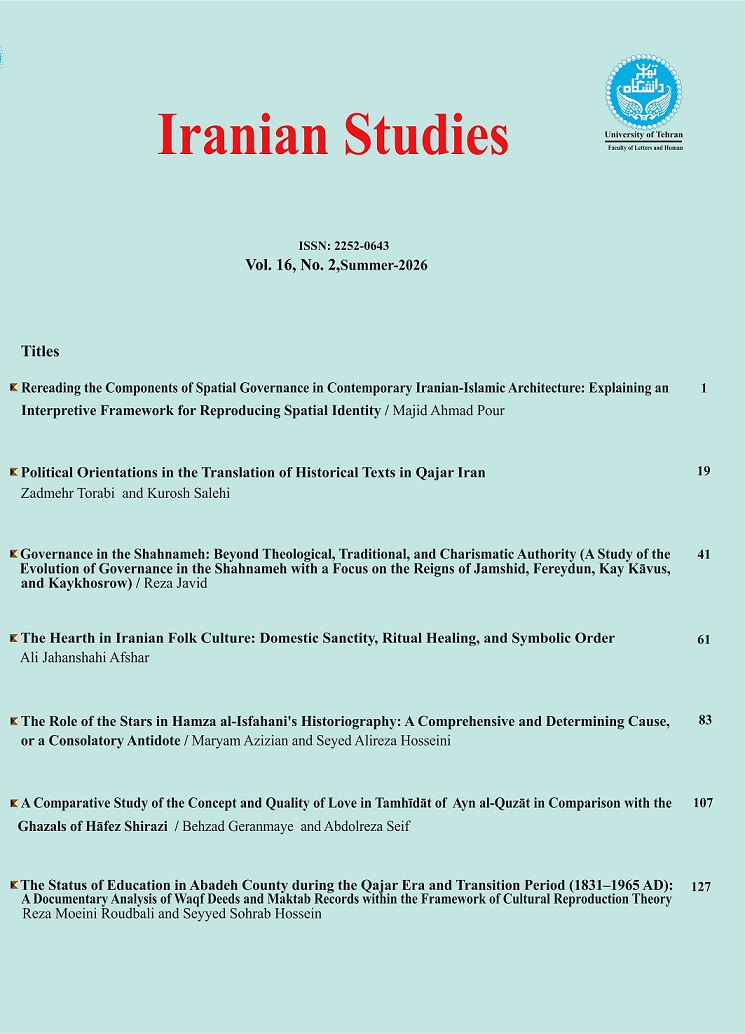
A Comparative Study of the Concept and Quality of Love in Tamhīdāt of ʿAyn al-Quḍāt in Comparison with the Ghazals of Ḥāfeẓ Shirazi

Articles in Press, Accepted Manuscript, Available Online from 24 June 2025

https://doi.org/10.22059/jis.2025.393666.1343

abdolreza seif, Behzad Geranmaye

Abstract This study undertakes a comparative examination of the concept and quality of love in two prominent works of Persian mystical literature: Tamhīdāt by ʿAyn al-Quḍāt Hamadānī and the Ghazals of Ḥāfeẓ of Shiraz. The primary objective of this research is to analyze and compare the perspectives of these two eminent mystical thinkers on the notion of love, with particular emphasis on its ontological, epistemological, and spiritual dimensions. Love, as one of the most fundamental concepts in Islamic mysticism, is a multifaceted, complex, and dynamic phenomenon that, when confronted with notions such as reason, religious law, mystical experience, and intuitive knowledge, reveals diverse interpretations and expressions. While certain key themes—such as the dominance of love, the conflict between love and intellect, heedlessness, and the origin of love—are commonly found across various mystical texts, a close comparative analysis reveals significant parallels between ʿAyn al-Quḍāt’s views on love and the themes presented in Ḥāfeẓ’s poetry. Utilizing qualitative content analysis as its methodological framework, this study identifies and examines the key symbols, metaphors, and motifs related to love in both works, mapping the similarities and differences in their conceptualizations. Ultimately, while it is not possible to definitively assert a direct influence of ʿAyn al-Quḍāt on Ḥāfeẓ, the textual evidence indicates a profound, meaningful, and undeniable intellectual connection between the mystical thought of these two influential figures in the history of Persian Sufism.

Gilooyeh clan and their social political role in Abbasids period (2nd and 3rd centuries)

Gilooyeh clan and their social political role in Abbasids period (2nd and 3rd centuries)

Volume 2, Issue 1, Summer 2013, Pages 83-103

https://doi.org/10.22059/jis.2012.35224

Keshvad Siahpour

Abstract Gilooyeh clan or rouzbeh family was one of the most famous and effective Iranian clans of Fars during the first three centuries Sassanids who was gradually successful to penetrate in Abbasid Caliphate and to show their important roles in social- political events, in addition to their periodic battles with aggressive and dominant Arabs. Gilooyeh himself who was the most famous and prominent member of his clan to the scale that made him to rule a wide part of Fars and the region was named Gilooyeh after him.Gathered a great army and fought the clan of Abu Dolafe Ejli who attended and dominated on some parts of Iran, particularly the Persian Iraq ,from 2nd century.Despite the temporary successes and the death of the Maaqal, the brother of Abu Dolafe, he was finally killed.His vast territory, included regions from about Shiraz to Semirom, Lordegan, Arejan( Behbahan), some parts of the Persian Gulf shores, Mamasani, Kohgiluye and Boyer Ahmad, was considered as the territory of his clan. His sons, Khalid and Hassan, and his grandson, Muhammad bin Hassan attended and influenced in the court of Abbasid Caliphs and kept the important role of the clan on. This article, accomplished on a historical library method, is trying to reply to this question: “what was the social and political role of the Iranian Gilooyeh clan in Abbasid caliphate?”

From Alexander, the Cursed to Alexander, the Dhu’l-Qarnayn Assessment of disorders in historical sources about Alexander, the King of Macedonia (PartII)

From Alexander, the Cursed to Alexander, the Dhu’l-Qarnayn Assessment of disorders in historical sources about Alexander, the King of Macedonia (PartII)

Volume 3, Issue 1, Summer 2013, Pages 65-84

https://doi.org/10.22059/jis.2013.36347

Bahman Firouzmandi Shireh Jin, Mehdi Rahbar, Mostafa Deh Pahlavan

Abstract Hellenism is a part of Iran’s historical period. This era starts with the devastating onslaught of Alexander, the Macedonian warlord. Our historical sources introduce Alexander with a collection of mythic-historical features which make us visualize the real Alexander with an ambiguous image. The conflicting viewpoints of eastern and western historical works in pre-Islamic periods can be the reason for this scrutiny. Specially, the eastern works which show the formation of an intellectual movement and the religious resistance of Iranian society and their clergies in Hellenist, Parthian and Sassanid periods against Hellenistic traditions. The quality of Iranian and Muslim historians’ deviation from depending on western sources and historical works would be clear through studying Alexandropedias and Islamic sources.         

The Problem of Geographical Center and the Continuity of Power in  Khwarazmshahi Dynasty (598-628/1202-1231)

The Problem of Geographical Center and the Continuity of Power in Khwarazmshahi Dynasty (598-628/1202-1231)

Volume 3, Issue 1, Summer 2013, Pages 33-52

https://doi.org/10.22059/jis.2013.36345

Rasoul Jafarian, Maryam Kamali

Abstract The geographical scope of a dynasty and the selection of a capital as the center of its power can be considered as the essential factors in the establishment of a regime and its continuity; this matter seems to be neglected in the political structure of Khwarazmshahi dynasty (598-628/1202-1231). The Khwarazmshahi which were supposed to change into one of the greatest medieval dynasties led the course of political changes in a different direction.  After having conquered the Saljuq dynasty, the Khwarazmshahi chose a centralized political structure. But the selection of Khwarazm as the only center of power and the lack of continuous connection with their vast territory caused the fast decline of Khwarazmshahi power. On the basis of original resources, this article explores the relationship between the geographical scope of a dynasty and its political structure. Moreover, this paper examines the causes of Khwrazmshahi’s decline with regards to its political structure and the selection of Khwarazm as the capital.


Study of Achaemenid Period work’s in Lycia Satrapi’s

Study of Achaemenid Period work’s in Lycia Satrapi’s

Volume 3, Issue 1, Summer 2013, Pages 99-118

https://doi.org/10.22059/jis.2013.36349

Ali Reza Hejebri Nobari, Mahsa Veisi, Mehdi Mousavi, Javad Neyestani

Abstract Achaemenid ruled over a vast territory, to which included Asia Minor (modern Turkey), that was conquered during Cyrus the great campaign to Lydia. Following this its cities was added to Persian satrapies. The name of all the Persian satrapies was not mentioned in Achaemenid official texts, because Achaemenid political style was in this way that the conquered areas came under the central power control while having their own selves government; Lycia is one of those their name are not mentioned in none of official texts, but Greek historian called it Persian satrapy. This research aim to answer the question that which kind of ancient artifacts have been remained to prove, Lycia was indeed one of Persian satrapies.The majority of archaeological material cultures from Xanthos – capital of Lycia- are reliefs similar to Persepolises which could prove their presence in the region.


Analysis of Wood Delicacy of Touch Art and its Artists in Sanadaj from the Qajar Period until now

Analysis of Wood Delicacy of Touch Art and its Artists in Sanadaj from the Qajar Period until now

Volume 3, Issue 2, Summer 2014, Pages 33-51

https://doi.org/10.22059/jis.2014.51697

Mohammad Ebrahim Zarei

Abstract Nazok Kari, One of the Woodwork art, is of arts that functional and artistic instruments has made from well paint woods by Eleganceand precision.The evidences and documents indicated that OrosiSazi (sash making art) and, Consequently, the Nazok Kariwas expanded in Sanandaj city from Safavidperiod. Due to reasons such as lack of professional Craftsmen and high cost, thesash making art (OrsiSazi) activities don’t have thrivednow; But the Nazok Kari is still flourishing. While Nazok Kari works of Safavid period is not found in Sanandaj yet, but those of Qajar Period is remained 
 The questions related on this subject can be asked in this way. The first that arises is the peak of Nazokkari art was during the Qajar? The investigations show that the peak of flourishing of it was at the middle of Qajar period and on wards. The second question, how much the Sanandaj artists were able to reach to a unique style in the field of Nazok Kari art? It seems that the artist in the field of Nazokkari in Sanandaj started their work according to their style and way of wooden art throughout whole Iran, but given to climate, time passing and demands, gradually the special way was found. The aim of this research is to analysis the wooden art and the sort of artist work in this field from Qajar time until now. The resources of this research are based on the field activities and library studies. Therefore, the research method is explanative-analytical. It seems that the suitable ground for growth and development on the one hand and artist’s attempts on the other hand, is caused stability and improvement on this art. This paper is about the history of wooden arts, the methods of wood supply and extraction of walnut roots, Nazokkari art, the tools of Nazok Kariart, different steps of coloring with polish and alcoholand NazokKar’sartists.

The Siting of Jay and Yahudiya Cities in the Rostāq-i Jay of Isfahan and the Change in the Seat of Power until the Rise of Seljuks

The Siting of Jay and Yahudiya Cities in the Rostāq-i Jay of Isfahan and the Change in the Seat of Power until the Rise of Seljuks

Volume 4, Issue 1, Summer 2014, Pages 57-76

https://doi.org/10.22059/jis.2014.52668

Ali Shojaee Esfahani

Abstract The cities of Jay in pre-Islamic and Yahudiya in the post Islamic period were located in a plain delimited from three sides by surrounding heights. This area, referred to in historical and geographical documents as the Rostāq-i Jay, was the most important rural district of Isfahan's khora. With rising of Buyids, they decided to change the seat of power from Jay to Yahudiya and consequently the construction of the city wall. Given the complete destruction of both city,s wall, the only data available on their location are limited to the texts and few archaeological traces. Therefore, while analyzing the reasons for change of hub in Isfahan from Jay to Yahudiya, the article tries to determine the location of walls of Jay and Yahudiya in Jay district on the basis of geographical and historical texts, archeological evidence, old maps and satellite photos, and traces them on the current city,s map.
 

A Comparison between the two stories of Adam in Quran and Gayumarth in Shāhnāme

A Comparison between the two stories of Adam in Quran and Gayumarth in Shāhnāme

Volume 2, Issue 2, Winter 2013, Pages 19-33

https://doi.org/10.22059/jis.2013.35367

Soqra Salmani Nejad, Abdoreza Seif

Abstract Expression of similarities and dissimilarities between historical and mythical characters can show the continuous bilateral impressions and effects of History and Myth and their results. Gayumarth, being absolutely different in appearance with modern man, has always been considered as the first Man in Persian Mythology. However, in Shāhnāme, Ferdowsi never considers him as the first Man. It is somehow because of Ferdowsi’s Quranic and Islamic view point about the creation of the first Man that he calls Gayumarth the first King. In the present paper, the aim is to try to express all similarities and dissimilarities which exist between these two characters in Quran and Shāhnāme. Subjects such as choosing mountain as the first place of life, being killed by their children, having the title of First, and being introduced as a single character in some historical books are being analyzed in this present essay.            

Publication Information
Indexing and Abstracting

Keywords Cloud