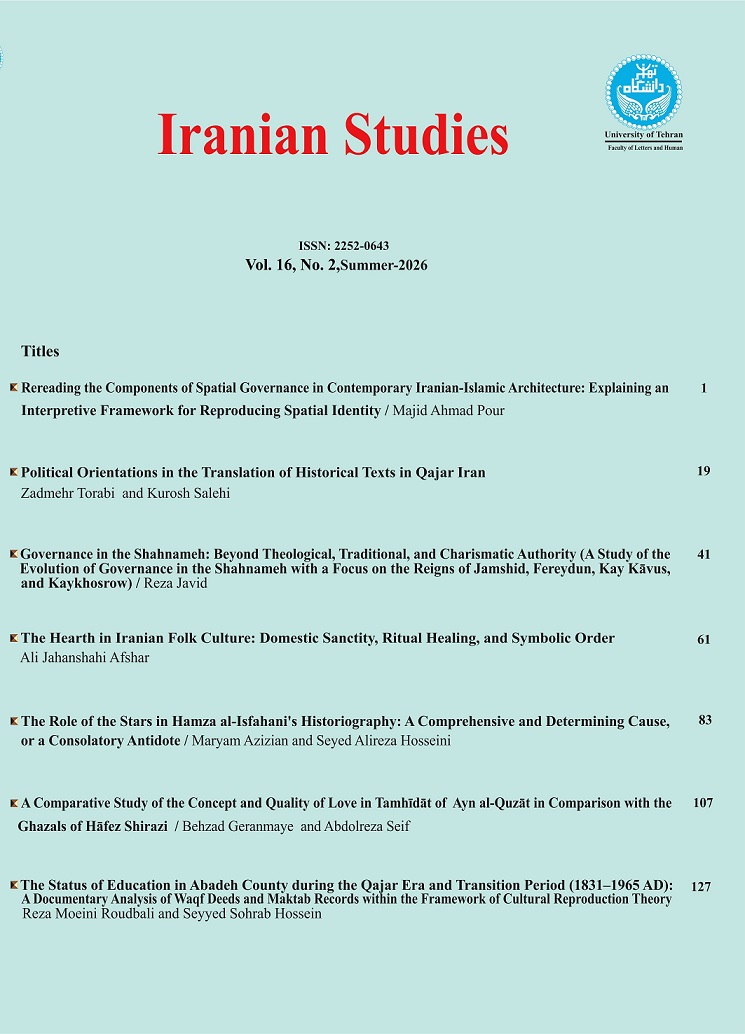
Iranian-Islamic architecture, as one of the most important manifestations of Iranian identity and civilization, has faced challenges in the field of spatial identity continuity in recent decades under the influence of social, economic, and managerial developments. The rupture between cultural values, principles of vernacular architecture, and contemporary processes of space production has in many cases led to the weakening of the identity coherence of architectural environments. Therefore, the present study aimed to review the components of spatial governance in contemporary Iranian-Islamic architecture and to explain an interpretative framework for reproducing spatial identity. This study is applied in terms of purpose and qualitative in terms of approach with a descriptive-interpretative nature that was conducted using a case study strategy. The research population included professors, elites, and experts in this field, 23 of whom were selected through purposive sampling and based on the principle of theoretical adequacy. Data were collected through semi-structured interviews and examined using Glaser's data-driven approach and interpretive analysis of the themes. The findings of the study showed that spatial governance in contemporary Iranian-Islamic architecture is multidimensional in nature and the reproduction of spatial identity is affected by the interaction of five main dimensions including cultural-identity, managerial-institutional, social-participatory, aesthetic-physical, and eco-oriented components. Also, weak institutional cohesion, dominance of economic logic over spatial decision-making, reduced social participation, and distancing from indigenous principles were identified as the most important factors weakening spatial identity.
Ardalan, N., & Bakhtiar, L. (1973). The Sense of Unity: The Sufi Tradition in Persian Architecture. University of Chicago Press. https://press.uchicago.edu
Bahreini, S. H. (2015). Analysis of Urban Spaces and Urban Identity. University of Tehran Press.[ In Persian].
ahmad pour, M. (2026). Rereading the Components of Spatial Governance in Contemporary Iranian-Islamic Architecture: Explaining an Interpretive Framework for Reproducing Spatial Identity. Iranian Studies, 16(2), 1–17. https://doi.org/10.22059/jis.2026.416257.1418
MLA
ahmad pour, M. "Rereading the Components of Spatial Governance in Contemporary Iranian-Islamic Architecture: Explaining an Interpretive Framework for Reproducing Spatial Identity", Iranian Studies, 16, 2, 2026, 1–17. doi: 10.22059/jis.2026.416257.1418
HARVARD
ahmad pour, M. (2026). 'Rereading the Components of Spatial Governance in Contemporary Iranian-Islamic Architecture: Explaining an Interpretive Framework for Reproducing Spatial Identity', Iranian Studies, 16(2), pp. 1–17. doi: 10.22059/jis.2026.416257.1418
CHICAGO
ahmad pour, M., "Rereading the Components of Spatial Governance in Contemporary Iranian-Islamic Architecture: Explaining an Interpretive Framework for Reproducing Spatial Identity." Iranian Studies, 16 2 (2026): 1–17, doi: 10.22059/jis.2026.416257.1418
VANCOUVER
ahmad pour M. Rereading the Components of Spatial Governance in Contemporary Iranian-Islamic Architecture: Explaining an Interpretive Framework for Reproducing Spatial Identity. Iranian Stud. 2026;16(2):1–17 (In Persian). doi: 10.22059/jis.2026.416257.1418