Subjects = Click subject name to see related articles.
Number of Articles: 96
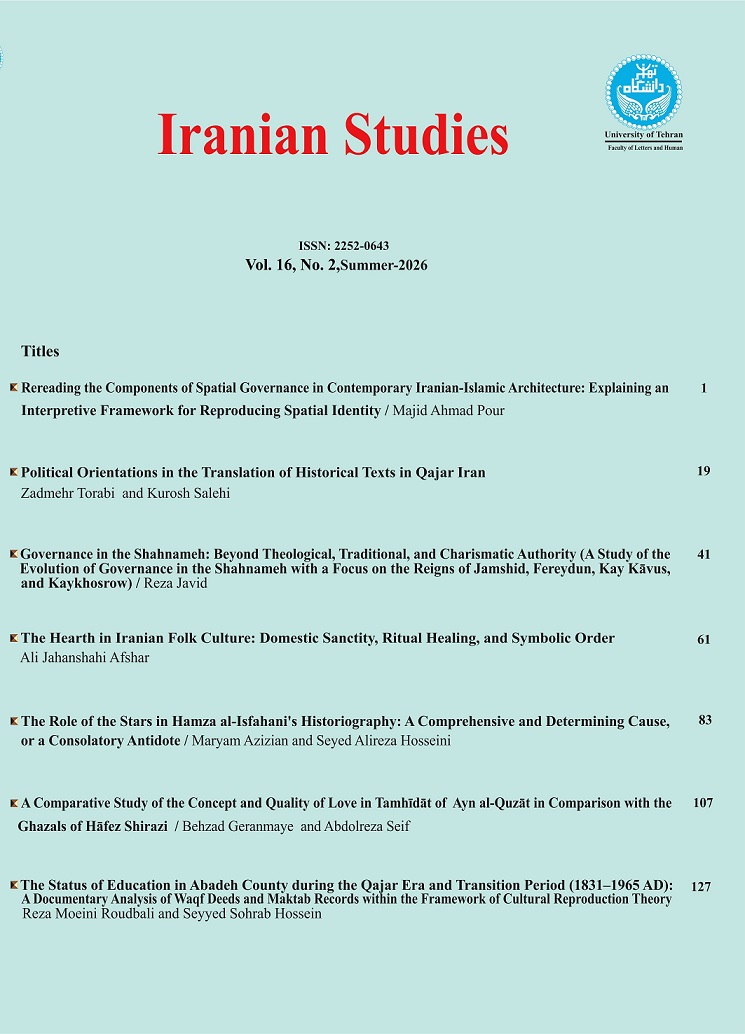
Rereading the Components of Spatial Governance in Contemporary Iranian-Islamic Architecture: Explaining an Interpretive Framework for Reproducing Spatial Identity

Rereading the Components of Spatial Governance in Contemporary Iranian-Islamic Architecture: Explaining an Interpretive Framework for Reproducing Spatial Identity

Volume 16, Issue 2, Summer 2026, Pages 1-17

https://doi.org/10.22059/jis.2026.416257.1418

majid ahmad pour

Abstract Iranian-Islamic architecture, as one of the most important manifestations of Iranian identity and civilization, has faced challenges in the field of spatial identity continuity in recent decades under the influence of social, economic, and managerial developments. The rupture between cultural values, principles of vernacular architecture, and contemporary processes of space production has in many cases led to the weakening of the identity coherence of architectural environments. Therefore, the present study aimed to review the components of spatial governance in contemporary Iranian-Islamic architecture and to explain an interpretative framework for reproducing spatial identity. This study is applied in terms of purpose and qualitative in terms of approach with a descriptive-interpretative nature that was conducted using a case study strategy. The research population included professors, elites, and experts in this field, 23 of whom were selected through purposive sampling and based on the principle of theoretical adequacy. Data were collected through semi-structured interviews and examined using Glaser's data-driven approach and interpretive analysis of the themes. The findings of the study showed that spatial governance in contemporary Iranian-Islamic architecture is multidimensional in nature and the reproduction of spatial identity is affected by the interaction of five main dimensions including cultural-identity, managerial-institutional, social-participatory, aesthetic-physical, and eco-oriented components. Also, weak institutional cohesion, dominance of economic logic over spatial decision-making, reduced social participation, and distancing from indigenous principles were identified as the most important factors weakening spatial identity.

Political Orientations in the Translation of Historical Texts in Qajar Iran

Political Orientations in the Translation of Historical Texts in Qajar Iran

Volume 16, Issue 2, Summer 2026, Pages 19-40

https://doi.org/10.22059/jis.2026.410445.1394

Zadmehr Torabi, Kurosh Salehi

Abstract During the Qajar period, the translation of historical texts into Persian surged in response to pressing societal demands, yet this practice was far from a purely historical exercise. Motivated by a desperate quest to diagnose the roots of Iran’s backwardness and to find a viable path to development, various translations emerged, with historical works drawing substantial interest from courtiers, statesmen, and reformists. Employing a historical methodology, this study critically examines the translation process of these historical texts and analyzes their underlying political orientations. It specifically investigates how political, cultural, and social factors influenced these translations, exploring existing orientations such as selectivity in content, deliberate distortions, and the strategic emphasis on certain themes. The findings indicate that these translations were carried out in a distinctly selective fashion, with their bias predominantly shaped by the imperatives of power and a focused interest in the careers of prominent European rulers. This selective process reveals that most translations were politically charged, often aligned with modern state theory, and fundamentally oriented toward identity-formation. As a result, while they had a relatively modest impact on deepening Iranians’ understanding of their own historical context and identity, they inadvertently set the stage for major intellectual developments in the subsequent era.

Governance in the Shahnameh: Beyond theological, traditional, and charismatic authority (A study of the evolution of governance in the Shahnameh with a focus on the reigns of Jamshid, Fereydun, Kikaus, and Kaykhosrow)

Governance in the Shahnameh: Beyond theological, traditional, and charismatic authority (A study of the evolution of governance in the Shahnameh with a focus on the reigns of Jamshid, Fereydun, Kikaus, and Kaykhosrow)

Volume 16, Issue 2, Summer 2026, Pages 41-60

https://doi.org/10.22059/jis.2026.408171.1391

Reza Javid

Abstract The legitimacy of rule in the Shahnameh is realized by emphasizing the Farr and Farr e Yazidi and Kayani. Despite these, the Shahnameh also emphasizes in some cases that Farr e Yazidi and Farr e Kayani are not always a protective halo of politics and power, but rather a false ladder that leads to autocracy and self-deification. According to Ferdowsi, this is the fate of the Pishdadi king of Jamshid. In the case of Kay Kāvus, the lack of some moral and social qualifications can also eliminate the halo surrounding the ruler. In these two cases, the political metaphysics of the ruler seems to be inadequate and requires a moral perspective. The representative of this moral perspective is Fereydun. However, Fereydoun's political metaphysics, along with his moral competence, finally reach their perfection in Kay Kāvus. Such a development necessitates the creation of a desirable governing institution and structure. But the inevitable logical consequence of such an institution and structure is the absence of the king as the ruling and full-fledged subject of politics. This article, while examining two forms of political legitimacy (metaphysical and moral) in the four mythical and epic kings of the Shahnameh, concludes that Keykhosrow goes beyond the limitations of the first two legitimities and comes to project the institution of governance, an institution that is focused on the efficiency, effectiveness, and general satisfaction of the subjects, rather than the divine grace and moral competence of the king and his personal presence in politics.

The Role of the Stars in Hamza al-Isfahani’s Historiography: A Comprehensive and Determining Cause, or a Consolatory Antidote

The Role of the Stars in Hamza al-Isfahani’s Historiography: A Comprehensive and Determining Cause, or a Consolatory Antidote

Volume 16, Issue 2, Summer 2026, Pages 83-105

https://doi.org/10.22059/jis.2026.416205.1417

Maryam Azizian, Seyed Alireza Hosseini

Abstract The principal subject of Hamza al-Isfahani’s History is chronology and the harmonization of the timelines of various nations. However, the work also contains numerous reports related to astrological judgments, which introduce a distinctive layer of complexity. The present study investigates how and why astrological prognostications are interwoven with historical narratives in Hamza’s text. The findings suggest that Hamza al-Isfahani resorted to the influence of celestial bodies and prognostication as causal forces in both the recent past and his own contemporary context. Through this approach, he sought, first, to alleviate the anguish caused by Arab domination over Iranians; second, to convey a message of hope to his contemporaries by anticipating the collapse of the prevailing ineffective order, the end of recurrent instability, and the imminent emergence of a more favorable era; and third, to shield himself from potential repercussions arising from his views on contemporary history. The astrological predictions in Hamza’s History stand in a compelling tension with a traditionist, God-centered framework and an eschatological outlook

A Comparative Study of the Concept and Quality of Love in Tamhīdāt of ʿAyn al-Quḍāt in Comparison with the Ghazals of Ḥāfeẓ Shirazi

A Comparative Study of the Concept and Quality of Love in Tamhīdāt of ʿAyn al-Quḍāt in Comparison with the Ghazals of Ḥāfeẓ Shirazi

Volume 16, Issue 2, Summer 2026, Pages 107-126

https://doi.org/10.22059/jis.2025.393666.1343

Behzad Geranmaye, Abdolreza Seif

Abstract This study undertakes a comparative examination of the concept and quality of love in two prominent works of Persian mystical literature: Tamhīdāt by ʿAyn al-Quḍāt Hamadānī and the Ghazals of Ḥāfeẓ of Shiraz. The primary objective of this research is to analyze and compare the perspectives of these two eminent mystical thinkers on the notion of love, with particular emphasis on its ontological, epistemological, and spiritual dimensions. Love, as one of the most fundamental concepts in Islamic mysticism, is a multifaceted, complex, and dynamic phenomenon that, when confronted with notions such as reason, religious law, mystical experience, and intuitive knowledge, reveals diverse interpretations and expressions. While certain key themes—such as the dominance of love, the conflict between love and intellect, heedlessness, and the origin of love—are commonly found across various mystical texts, a close comparative analysis reveals significant parallels between ʿAyn al-Quḍāt’s views on love and the themes presented in Ḥāfeẓ’s poetry. Utilizing qualitative content analysis as its methodological framework, this study identifies and examines the key symbols, metaphors, and motifs related to love in both works, mapping the similarities and differences in their conceptualizations. Ultimately, while it is not possible to definitively assert a direct influence of ʿAyn al-Quḍāt on Ḥāfeẓ, the textual evidence indicates a profound, meaningful, and undeniable intellectual connection between the mystical thought of these two influential figures in the history of Persian Sufism

The Status of Education in Abadeh County during the Qajar Era and Transition Period (1831–1965 AD): A Documentary Analysis of Waqf Deeds and Maktab Records within the Framework of Cultural Reproduction Theory

The Status of Education in Abadeh County during the Qajar Era and Transition Period (1831–1965 AD): A Documentary Analysis of Waqf Deeds and Maktab Records within the Framework of Cultural Reproduction Theory

Volume 16, Issue 2, Summer 2026, Pages 127-148

https://doi.org/10.22059/jis.2026.412347.1408

Reza Moeini roudbali, Seyed sohrab Hosseini

Abstract Education in Qajar Iran functioned as a dynamic social field for reproducing power relations and social prestige beyond a mere administrative structure. This study explains the organization of local education in Abadeh County (1210–1344 SH / 1831–1965 AD) by analyzing the structured relationship between the institution of Waqf (endowment) and the reproduction of cultural capital. The central research problem is how the local educational system operated without direct central government intervention and how regional elites managed this sphere within the decentralized administrative framework of the “Protected Domains” (Mamalik-i Mahrusah). Using a descriptive-analytical approach combined with a multi-level documentary analysis of 42 archival sources (including endowment deeds, school records, travelogues, and administrative correspondence from NLAI/SAKMA), this study employs Pierre Bourdieu’s “Cultural Reproduction” theory as its interpretive framework. The findings indicate that education in Abadeh functioned as an “autonomous field” grounded in the institutional logic of Waqf. In the absence of a centralized educational bureaucracy, Waqf served as a strategic mechanism for converting the economic capital of local elites into symbolic capital (prestige) and consolidating their socio-religious legitimacy. Furthermore, the transition to modern education in this region was not a sudden rupture, but rather a hybrid process built upon the foundation of traditional networks. The persistent silence of historical documents regarding the lower and marginalized classes also confirms the role of traditional education in reproducing structural inequalities under the guise of religious charity. Ultimately, this study emphasizes the necessity of revising macro-oriented and centralist narratives in the history of education, underscoring the critical role of “indigenous logics” in peripheral regions

The Role of Salaries and Religious Donations in Consolidating Achaemenid Political Power: A Documentary Analysis of the Persepolis Tablets

The Role of Salaries and Religious Donations in Consolidating Achaemenid Political Power: A Documentary Analysis of the Persepolis Tablets

Volume 16, Issue 1, Spring 2026, Pages 1-18

https://doi.org/10.22059/jis.2026.408992.1392

Mahshid Khoddami, Hossein Badamchi

Abstract The present study examines the multifaceted role of wages and religious offerings in consolidating and reinforcing political authority within the Achaemenid Empire, with particular emphasis on the ancient documentary evidence preserved in the Persepolis Fortification Tablets. The primary objective of this research is to provide a comprehensive analysis of the mechanisms through which ritual and economic resources were distributed among social, administrative, and religious groups, and to evaluate the impact of these practices on the legitimacy, stability, and durability of the imperial power structure. The research data consist of the extensive corpus of Persepolis Fortification Tablets, which have been meticulously examined and systematically coded using a rigorous documentary analysis methodology. The findings reveal that the system of payments, rations, and ritual allocations functioned not merely as an economic mechanism but also as a strategic instrument for strengthening the loyalty, cooperation, and compliance of court officials, priests, and local elites throughout the empire. Furthermore, a detailed geographical and structural analysis of these documents demonstrates a deliberate and clear correlation between the central authority in Persepolis and the distribution of wages in subordinate regions, reflecting a sophisticated approach to administrative control and political governance. The results highlight the critical role of religious offerings and state-administered wages as essential tools employed by the Achaemenids to legitimize their rule, stabilize social hierarchies, and maintain imperial cohesion. By providing new insights into the interplay between economic, ritual, and political dimensions, this study contributes to a deeper understanding of the organizational and ideological foundations of Achaemenid imperial power and offers a valuable perspective for reevaluating the empire’s economic and religious–political structures

Manichaeism and Its Zurvanian Roots: From Conceptual Interaction to Cosmological Opposition

Manichaeism and Its Zurvanian Roots: From Conceptual Interaction to Cosmological Opposition

Volume 16, Issue 1, Spring 2026, Pages 19-46

https://doi.org/10.22059/jis.2026.411642.1405

ّFarshad Farshbaf Abrishami, Majidreza Rajabi, Mehrnaz Behroozi

Abstract As one of the most significant Gnostic movements of late antiquity, Manichaeism emerged from the cultural and religious context of Iran. One of the most debated issues in Manichaean studies concerns the extent and nature of this religion's indebtedness to Zurvanism, an influential current within Sasanian Zoroastrianism. Adopting a comparative approach, this study demonstrates that Manichaeism's encounter with Zurvanism transcended mere borrowing, evolving into conceptual interaction and ultimately cosmological opposition.The central question addresses the extent of Zurvanian elements in Manichaeism and how this conceptual engagement led to cosmological confrontation between the two systems. Employing a descriptive-analytical method, this research draws upon Manichaean texts (including the Kephalaia and hymns), Pahlavi sources (such as the Bundahishn and Ardā Wirāz Nāmag), and historical accounts.Findings indicate that while Manichaeans adopted the concept of "Zurvan" as the god of boundless time, they fundamentally transformed its function. In Zurvanism, Zurvan holds a primordial and exalted position; in Manichaeism, however, he becomes symbol of the material world and imprisoning time—synonymous with the dark hell. This conceptual shift reveals a profound cosmological opposition: Manichaeism regards the world and time as absolute evil from which liberation is sought, whereas Zurvanism attempts to explain the origin of evil within a framework tending toward monotheism.Thus, Manichaeism appropriated Zurvanian myths to construct a new adversary for the God of Light, redefining Zurvan as embodiment of darkness and captivity. This study contributes significantly to understanding pre-Islamic Iranian religious interactions and their divergent approaches to the fundamental problems of evil and time. 

Iconographical Analysis and Iconological Interpretation of the Snake and Eagle Motif in the Jiroft Civilization (3rd Millennium BC)

Iconographical Analysis and Iconological Interpretation of the Snake and Eagle Motif in the Jiroft Civilization (3rd Millennium BC)

Volume 16, Issue 1, Spring 2026, Pages 47-68

https://doi.org/10.22059/jis.2025.393018.1341

Esmaeil Sangari, Shaghayegh Taheri Bakhtiarvand

Abstract In January 2001, a common surge within the southeastern area of Kerman, Iran, uncovered an obscure culture in Jiroft. The surge revealed artifacts that each uncover a covered up corner of the obscure culture of the people of Jiroft within the third thousand years BC. In spite of the disclosure of an obscure composing framework in Jiroft culture, the pictures utilized on the artifacts of this culture are of evident significance. Distinctive human, plant, creature, structural, and human-animal images are apparent on these artifacts. To get it and studied the existing images, the as it were way out is to examined the iconographic and iconological themes of the themes and compare these themes with the neighboring civilizations of the culture. Iconographic consider makes it conceivable to get to the scholarly substance, myths, and stories related to the themes. In differentiate, iconological consider will lead to an understanding of the genuine foundation of the discovered motifs in terms of time and put within the center of the society in address. One of the foremost common images utilized in Jiroft vessels is the motif of the fight of the hawk and the wind. The predominance of this picture within the craftsmanship of the obscure culture of Jiroft certainly contains covered up concepts that the Jiroft craftsman tries. In the research, reference has been made to the analysis of the images of the eagle and the snake in religious and literary texts such as Bondahesh and Kalīla wa Dimna. On the other hand, through a comparative study, the explanation of the said icon in neighboring civilizations of the Jiroft in the third millennium BC has been pointed out. The show inquire about, based on library assets and descriptive-analytical strategies, serious to look at this not-so-well-known culture through the investigation and translation of the theme in address

Proposal for Determining the Function and Chronology of Qaleh Dokhtar (Maidens Fortress) of Sāveh

Proposal for Determining the Function and Chronology of Qaleh Dokhtar (Maiden's Fortress) of Sāveh

Volume 16, Issue 1, Spring 2026, Pages 69-97

https://doi.org/10.22059/jis.2024.365574.1231

Ismail Sharahi, Mohammad Ebrahim Zarei, Hamide Choubak

Abstract The structure of Qaleh Dokhtar (also known as Qiz Qal'eh or Qiz Qal'eh) is a mountain fortress situated 25 kilometers southwest of Sāveh, atop a solitary mountain in the Hendeš mountain range. Numerous studies have been conducted on the origins and function of this structure, yet they have yielded divergent conclusions. Some researchers attribute the construction of Qaleh Dokhtar to the Sasanian period, positing its function as a temple dedicated to the goddess Anāhitā. Others have identified it as a fortress from the Islamic Middle Ages, associated with the Ismaili sect. The lack of substantial evidence and documentation from these researchers has created a greater need for meticulous examination of primary written sources, the historical-geography of Sāveh, and the existing studies of the monument. This research is predicated on the hypothesis that Qaleh Dokhtar, owing to its name, its strategic location, references in historical sources, its connection to specific natural features and phenomena, and archaeological findings, was constructed during the Sasanian period and functioned as a shrine to the goddess Nahid (Anāhitā).The methodology employed in this study is historical-analytical, based on field observations, architectural evidence, archaeological excavations, and a thorough review of library sources. The research and analysis conducted suggest that while the foundations of Qaleh Dokhtar may have been laid in the Sasanian period as a place of worship, the absence of definitive material evidence from that era, combined with the discovery of artifacts proving the structure's use during the Islamic Middle Ages and its clear association with other regional fortresses, makes its identification as an Ismaili castle a more plausible and acceptable conclusion

From Syncretism to Rationalism: Examining the Threefold Approaches to Iranian Mythology in the Historiography of the Seljuk Period (Based on Tarikh-e Sistan, Farsnameh, and Mujmal al-Tawarikh wa’l-Qisas)

From Syncretism to Rationalism: Examining the Threefold Approaches to Iranian Mythology in the Historiography of the Seljuk Period (Based on Tarikh-e Sistan, Farsnameh, and Mujmal al-Tawarikh wa’l-Qisas)

Volume 16, Issue 1, Spring 2026, Pages 99-122

https://doi.org/10.22059/jis.2026.405097.1380

hasan shahryari

Abstract Iranian myths are among the most fundamental components of national identity, which have undergone continuous reinterpretation in connection with political and religious transformations. Within this context, the Seljuk period represents a decisive juncture for readjusting the relationship between the Iranian mythical heritage and Islamic historiography, due to the establishment of Turkic rule, the rise of Ash'ari theological orthodoxy, and the continuity of the Iranian bureaucratic institution (divan). Employing a descriptive-analytical and comparative approach based on the concept of "Cultural Memory," the present study examines the treatment of Iranian myths in three pivotal texts: Tarikh-e Sistan, Farsnama, and Mujmal al-Tawarikh wa al-Qisas. The findings indicate that during this period, myth underwent a "functional displacement" and was reproduced through three distinct approaches: 1) The Syncretic Approach, aiming at the re-centering of sacred geography; 2) The Iranocentric Approach, serving as a model for political ethics and the restraint of power; and 3) The Rational-Critical Approach, which, through epistemic distancing, redefines myth as a written heritage and an "object of study."The overall conclusion suggests that myth did not decline during the Seljuk era; rather, by transforming from a "sacred belief" into an "identity strategy," it provided the necessary infrastructure for Iran’s historical continuity and its transmission to subsequent periods

A Structural and Content Analysis of the Taṣdīq-nāmeh of a Siyurghal Decree Issued by Tīmūr Gurkānī in Favor of Mīr Ikhtiār al-Dīn Ḥasan al-Ṭabāṭabāʾī al-Bihbahānī from the Late Zand Period

A Structural and Content Analysis of the Taṣdīq-nāmeh of a Siyurghal Decree Issued by Tīmūr Gurkānī in Favor of Mīr Ikhtiār al-Dīn Ḥasan al-Ṭabāṭabāʾī al-Bihbahānī from the Late Zand Period

Volume 16, Issue 1, Spring 2026, Pages 123-149

https://doi.org/10.22059/jis.2026.402271.1369

Seyyed Mohammad Mansour, Alireza Khazaei

Abstract The present article examines the structural and content-based aspects of a certification document related to a siyurghal decree issued by Tīmūr Gurkānī in favor of Mīr Ikhtiār al-Dīn Ḥasan al-Ṭabāṭabāʾī al-Bihbahānī. This taṣdīq-nāmeh of a Siyurghal Decree, written in the late Zand period (probably between 1201–1206 AH), is the only known document that extensively addresses not the original siyurghal decree issued by Tīmūr Gurkānī, but rather the formal confirmation of such a decree. The primary aim of this study is to conduct a thorough analysis of the internal and external elements of the taṣdīq-nāmeh of a Siyurghal Decree, examine the social status of the family that received the siyurghal, evaluate its historical authenticity, and compare it to existing examples of siyurghal decrees from various historical periods. This comparative analysis reveals that, unlike the original siyurghal decrees, such taṣdīq-nāmeh of a Siyurghal Decree were generally informal, non-bureaucratic documents whose legitimacy relied on the seals and testimonies of local elders, notables, and dignitaries. Accordingly, the document under examination stands as a unique case for identifying and evaluating taṣdīq-nāmeh of a Siyurghal Decree, particularly from the late Zand era. The authors in the present article have attempted, by structurally and content-wise examining the existing taṣdīq-nāmeh of a Siyurghal Decree and comparing it with the structure and content of Siurghal decrees based on previously published examples of Siurghal decrees, to identify the similarities and differences between these two types of documents and to distinguish their various aspects from one another

A Comparative Study of the Form and Content of Composite Creatures in the Lithographic Edition of Qazvini’s Ajāib al-Makhlūqāt and the Images of Mesopotamian Cylinder Seals

A Comparative Study of the Form and Content of Composite Creatures in the Lithographic Edition of Qazvini’s Ajāib al-Makhlūqāt and the Images of Mesopotamian Cylinder Seals

Volume 16, Issue 1, Spring 2026, Pages 151-176

https://doi.org/10.22059/jis.2026.411990.1409

Ahang Mirmongereh, Shohreh Javadi

Abstract The techniques employed in the engraving of images on Mesopotamian cylinder seals possess novel and unprecedented characteristics. These seals contain valuable information about the rituals, beliefs, and intellectual structures of the societies of that period. With the appearance of images of composite creatures from the third millennium BCE, a fundamental transformation occurred in the depiction of these beings particularly in the form of gods, goddesses, and supernatural entities in Mesopotamian civilization. It appears that the origins of many composite creatures in various later mythological, historical, and geographical narratives are rooted in these early images. The aim of this research is a comparative study of the engraved images on Mesopotamian cylinder seals and the shared visual elements, in terms of form and content, found in the depictions of composite creatures in the lithographic edition of Zakariya Qazvini’s Ajāib al-Makhlūqāt. The research question asks what formal and content-related relationship exists between the depictions of composite creatures in Qazvini’s book and the images on Mesopotamian cylinder seals. Using a descriptive–analytical approach and focusing on identifying the origins and visual roots of these depictions, the present study examines the formal and content-related similarities between these two sets of images through comparative analysis. Based on the visual findings of this study, the imagery on cylinder seals of the Mesopotamian civilization gradually persisted in subsequent civilizations within the same geographical region, as well as in neighboring ones. This cultural continuity is observed during the Qajar era in the form of legends and myths in the lithographed book Ajāib al-Makhlūqāt. By comparing these images in terms of both form and content, it appears that the depictions of composite creatures in this book have their roots in the motifs found on Mesopotamian cylinder seals

Evidences of Sasanid art in the Eastern States and its influence on Chinese art
(Case study: pearl decorations)

Evidences of Sasanid art in the Eastern States and its influence on Chinese art (Case study: pearl decorations)

Volume 15, Issue 4, Winter 2026, Pages 1-29

https://doi.org/10.22059/jis.2023.362774.1216

Mina Rastgar fard, Yaghoub Mohammadifar, Esmail Hemati Azandaryani

Abstract Pearl is one of the most frequently used ornaments in Sassanid decoration arts which, as a valuable element and the symbol of divine glory in religious and nonreligious figures. In the Sassanid era comprehensive and vast connections with the east was formed which led to exchange of cultural concepts and content of Sassanid art with those countries. The wide-range reach of Persian culture and its expanse and popularity in China on the Silk Road is one of the main focuses of this research; and thus, the study of pearl decorations as an index of most repeated common decorations in Sassanid era, especially particular art of the courtiers and nobles, has been considered. This study aims to answer two important questions: By studying the pearl motifs, the influence of the artistic and religious thinking of the Sassanid court on Chinese civilization can be examined from what aspects? Was the usage of pearl depictions in Chinese arts consciously or was it a mere imitation of Sassanid royal arts as a new and luxurious commodity or tradition? The nature of current study is fundamental and its approach is descriptive, analytical-comparative and the data gathering method is of library type. In this study culture refers to distinct and unique parts of artistic tastes and thoughts, architectural decorations, textiles and other artworks that had an impact on Chinese culture. The considered geographical expanse includes documents achieved in the eastern Sassanid provinces and further the study of its impact along the Silk Road through China. The pearl decorative elements used in Buddhist temples, Sogdian tombs or Manichaean sources are not merely imitations derived from the Sassanid aesthetic concept; Rather, it is a conscious choice of its original concept and then the application of this art in a new religious and cultural context. It seems that the main factor in introducing the Sassanid culture to the neighboring nations is trade along the Silk Road, in front of the presence of numerous ambassadors and the sending of various gifts from the Sassanids to the Chinese court.

Philanthropy and its dimensions in Zoroastrianism

Philanthropy and its dimensions in Zoroastrianism

Volume 15, Issue 4, Winter 2026, Pages 31-48

https://doi.org/10.22059/jis.2025.380726.1303

Farahnaz Shams, Kolsoum Ghazanfari

Abstract Among the important concepts in Zoroastrianism, philanthropy is highly recommended and has received special attention. Philanthropy has a wide scope and dimensions, and knowing its examples, scope and mechanisms can clarify its individual, social, spiritual and cultural functions. Considering the impact of philanthropy on the morality and life of individuals and society, the explanation of this concept can clarify the perception and view of society and individuals towards it. The purpose of this article is to examine philanthropy and its dimensions in Pahlavi texts that were formalized in the Sasanian period or the first Islamic centuries. Depending on the period in which these texts were written, it is possible to learn about the definitions and activities of individuals, religious institutions and the state apparatus in this field, which required interaction between them. Studies show that the interests of the individual and the family, the community and the religious community were taken into account in the discussion of philanthropy.

Among the important concepts in Zoroastrianism, philanthropy is highly recommended and has received special attention. Philanthropy has a wide scope and dimensions, and knowing its examples, scope and mechanisms can clarify its individual, social, spiritual and cultural functions. Considering the impact of philanthropy on the morality and life of individuals and society, the explanation of this concept can clarify the perception and view of society and individuals towards it. The purpose of this article is to examine philanthropy and its dimensions in Pahlavi texts that were formalized in the Sasanian period or the first Islamic centuries. Depending on the period in which these texts were written, it is possible to learn about the definitions and activities of individuals, religious institutions and the state apparatus in this field, which required interaction between them. Studies show that the interests of the individual and the family, the community and the religious community were taken into account in the discussion of philanthropy.

The conceptual image of Iran in the Shiite discourse of the Safavid era
(with emphasis on reciting Roza Al-Anwar Mullah Muhammad Baqer Sabzevari)

The conceptual image of Iran in the Shiite discourse of the Safavid era (with emphasis on reciting Roza Al-Anwar Mullah Muhammad Baqer Sabzevari)

Volume 15, Issue 4, Winter 2026, Pages 49-64

https://doi.org/10.22059/jis.2024.378202.1293

Fatemeh Taherkhani, Heydar valizadeh

Abstract The purpose of writing this article is to investigate the language mechanisms in the Shiite discourse that led to the recovery and revival of the concept of "Iran" in the Safavid era.The importance of dealing with this concept is because many social-political relations and relationships, ways of power generation, how to form the Iranian-Islamic identity, and how to build a centralized Shiite government are hidden in its underlying layers of meaning. One of the important texts of this period, which was written in the style of a political book in the year 1402 AH and was dedicated to Shah Abbas II, is the book Roza Al-Anwar by Mullah Mohammad Baqer Sabzevari.This book, with its frequent use of the word Iran, is a good example for examining the way Iran and Shiism are discursively blended as two pillars of identity in contemporary Iran. By reading this text in accordance with Ryan Kozlak's conceptual history approach and Ruth Wodak's historical-discursive method, the following results were obtained:The concept of Iran has been mentioned and used in the widest semantic and historical form in this text, and all the discursive and semantic capacities available in it, including mythological, geographical, religious and cultural forms, have been used to produce the political power of the all-embracing and emerging Safavid state. and all levels and layers of historical meaning of this concept have been summoned in this text.

Woman as the Other in Qajar-Era Travelogues: A Critical Reading through Narrative Identity, Power/Knowledge, and the Third Space

Woman as the Other in Qajar-Era Travelogues: A Critical Reading through Narrative Identity, Power/Knowledge, and the Third Space

Volume 15, Issue 4, Winter 2026, Pages 65-84

https://doi.org/10.22059/jis.2025.402095.1368

somayeh Abbasi, Somayeh Khanipour

Abstract Historical–literary studies of the Qajar era—especially travelogues—have often settled for superficial, stereotypical depictions of women and neglected deeper discursive analysis. Aiming to fill this analytical gap, the present study examines the process of “othering” of Iranian and Western women in these texts and asks how the representation of women in travelogues, at the intersection of patriarchal and colonial discourses, has led to the effacement or redefinition of female subjectivity. Using a qualitative–critical analysis of a corpus of Iranian and Western travelogues, and drawing on an intertwined theoretical framework of Paul Ricoeur’s narrative identity, Michel Foucault’s power/knowledge, and Homi Bhabha’s concepts of double representation and the third space, the study’s preliminary data indicate that images of women are not neutrally rendered or derived from social realities; rather, they are ideological constructions formed at the boundary between internal patriarchal and external Orientalist discourses, ultimately resulting in the erasure or distortion of female subjectivity. Deeper findings show that the discourse of power has been exercised upon the Iranian female body; yet, paradoxically, travelogues also reflect traces of women’s agency and resistance in political, economic, and social arenas. These forms of agency are analyzable within the “third space” and contribute to redefining female identity in the face of stereotypes.

Namri; An ancient land in a part of Ilam province?

Namri; An ancient land in a part of Ilam province?

Volume 15, Issue 4, Winter 2026, Pages 85-103

https://doi.org/10.22059/jis.2023.358270.1197

Sorena Firouzi, Muhammad amin Saadat mehr, Zohre Jozi

Abstract The study of Mesopotamian inscriptions, especially from the Middle and Neo-Assyrian periods, has provided researchers with much geographical data. Based on the topographical coordinates provided by this information, the cultural and historical background of the western and central regions of the Iranian plateau has been better investigated. This process has formed the basis for many historical, cultural, and archaeological studies. Assyrians gradually began to pay attention to the east of their land from the era of Tiglath-Pileser I, and this view gained strength during the Neo-Assyrian periods. Therefore, in this upcoming research, we will use the geographical basis of the royal inscriptions of the Neo-Assyrian kings to investigate which territories described in those written documents corresponded to the boundaries of the current Ilam province or at least its northern part. This article demonstrates that contrary to opinions raised about the land of Namri, an important part of the coordinates of this ancient area coincided with the boundaries of Ilam province. Furthermore, this research argues that based on this conclusion and a study of the cultural components of Namri, we can gain a better understanding of the cultural state of the coordinates of Ilam province in the first millennium BCE .


The study of Mesopotamian inscriptions, especially from the Middle and Neo-Assyrian periods, has provided researchers with much geographical data. Based on the topographical coordinates provided by this information, the cultural and historical background of the western and central regions of the Iranian plateau has been better investigated. This process has formed the basis for many historical, cultural, and archaeological studies. Assyrians gradually began to pay attention to the east of their land from the era of Tiglath-Pileser I, and this view gained strength during the Neo-Assyrian periods. Therefore, in this upcoming research, we will use the geographical basis of the royal inscriptions of the Neo-Assyrian kings to investigate which territories described in those written documents corresponded to the boundaries of the current Ilam province or at least its northern part.

The effectiveness of the possible relations of diplomacy on the institution of the family Emphasizing the drivers of governance in the Safavid era

The effectiveness of the possible relations of diplomacy on the institution of the family Emphasizing the drivers of governance in the Safavid era

Volume 15, Issue 4, Winter 2026, Pages 105-128

https://doi.org/10.22059/jis.2025.387372.1328

zahra sadat keshavarz

Abstract In this connection, Max Weber's theory and comparative strategy have been put as a basis so that an ideal type of family change in the demography of the history of most societies becomes a mechanism for speculating about the sociological causality of the change in family dimensions in the Safavid era, and because The influence of the family on the propulsion of governance, as mediating variables, the method of path analysis is adapted. The relevant hypothesis is that; the governors of Safavid rule have created the initial and possible grounds for changing the dimensions of the family. The question corresponding to the hypothesis is that; is it possible to consider the change of the dimensions of the family based on the governors of Safavid rule? Therefore, the analytical viewpoint of the research has voted for the threshold situation of changing the dimensions of the family, from broad to broad dimensions, in the Safavid era; because it is possible that the propulsion of power relations diplomacy have affected the development of the profession, and further, the development of the profession has influenced the possible passage of the extended family and indicates the possibility of the correctness of such an assumption. Of course, the aforementioned change was only a preface to the extensive text of the family change and had a completely preliminary status in the Safavid era, and it can only be proposed as a hypothesis-generating research in the realm of historical analysis.

Was Frēdōn, the Possessor of Three Powers, a Warrior, a Physician, or a Prophet? (Based on the Three Texts:  Sūdgar Nask, Waršt-Mānsar Nask and the Manichaean Text “dr”)

Was Frēdōn, the Possessor of Three Powers, a Warrior, a Physician, or a Prophet? (Based on the Three Texts: Sūdgar Nask, Waršt-Mānsar Nask and the Manichaean Text “dr”)

Volume 15, Issue 4, Winter 2026, Pages 129-150

https://doi.org/10.22059/jis.2025.389555.1336

Poorchista Goshtasbi Ardakany, Zohreh Zarshenas, Farzaneh Goshtasb

Abstract Frēdōn is one of the most famous mythical heroes of Iran who defeated Zahhak and imprisoned him on Mount Damavand. In this study, the myths about Frēdōn that appear in the Sūdgar Nask and Waršt-Mānsar Nask, along with the Manichaean text “dr”, in which Frēdōn’s name is mentioned as the destroyer of fever and disease, are compared with the Avesta and Zand to determine whether the myth of Frēdōn in these texts is authentic or not. According to the investigations, it was found that the myth of “beating and imprisoning Zahhak by Frēdōn” is an original myth that is also found in Avesta and is also mentioned in the Shahnameh, Garshaspnameh, and Kushnameh with similarities to the Sūdgar Nask. The myth of “Frēdōn’s use of enchantment and magic to overcome the Māzandar Daēvas” is not original and was created by the guest verses in this chapter, and it has not been mentioned in the Shahnameh and Kushnameh.The myth of “Frēdōn’s healing and his struggle with fever and illness” that appears in the Manichaean text “dr” is an original myth and appears in the Avesta. The myth of “Ohrmazd’s offering the mission of religion to Frēdōn and Frēdōn’s disobedience to Ohrmazd” that is mentioned in the Waršt-Mānsar Nask is a created myth and is made by the guest verses mentioned in this chapter.

A Comparative Analysis of Moral Virtues and Vices in Ferdowsi’s Rostam and Sohrab and Matthew Arnold’s Sohrab and Rostum

A Comparative Analysis of Moral Virtues and Vices in Ferdowsi’s Rostam and Sohrab and Matthew Arnold’s Sohrab and Rostum

Volume 15, Issue 3, Autumn 2025, Pages 1-24

https://doi.org/10.22059/jis.2025.399999.1363

mohammad mirnezami, homeira zomorrodi, Abdolreza seif

Abstract Epic literature has long provided a platform for representing moral and cultural thought. The story of Rostam and Sohrab in Ferdowsi’s Shahnameh and its re-creation in Matthew Arnold’s narrative poem Sohrab and Rustum serve as examples of the connection between epic and ethics. This study conducts a comparative analysis of moral virtues and vices in these two works, showing how both poets—despite temporal and cultural distance—shape their narratives according to different moral frameworks. It also explores how a shared narrative can, within distinct cultural contexts, convey divergent ethical messages. The research method is descriptive–analytical, based on both quantitative and qualitative study of the texts. Moral virtues and vices were identified through the intellectual sources of each poet, then tabulated, and their frequency and application examined. Findings reveal that Ferdowsi, by emphasizing courage, family loyalty, dignity, and benevolence, creates a moral world in which good triumphs over evil. In contrast, Arnold focuses on family affection, friendship, and love, while also highlighting vices such as pride, ill temper, and misconduct. The ethical approach of Ferdowsi and Arnold influences the rhetorical and narrative structure of their works. Both writers organize their retelling of the story in line with their moral systems, making ethics central to genre and narrative style

Analysis of Geometric Volume Evolution from the Perspective of Muslim Scholars since the First to the Fifth AH centuries

Analysis of Geometric Volume Evolution from the Perspective of Muslim Scholars since the First to the Fifth AH centuries

Volume 15, Issue 3, Autumn 2025, Pages 25-44

https://doi.org/10.22059/jis.2024.367308.1241

Aref Azizpour Shoubi, Ahad Nejad Ebrahimi, Yaser Shahbazi

Abstract Geometry plays an integral role in the architectural production of all cultures. Islamic scholars classified it into categories. In treatises of scholars and professionals, volume geometry was one manifestation of this science. Understanding the relationship between thinking about volume and geometry among Muslim mathematicians in different eras is important for understanding volume geometry in Iranian architectural works. This research focuses on the beginning of Islam until the 5th century Hijri. Its purpose belongs to the basic-theoretical category. Interpretive-historical research has been used to answer: Geometry is classified as a science according to what basis? How have Muslim mathematicians viewed volume geometry in light of this classification? Al-Farabi divided geometry into theory and practice, and Akhwan al-Safa attributed mystical aspects to Pythagorean thinking. Emphasis on practice in Islamic classification reflected the importance of applying theory. This transformed volume geometry from abstract topics—such as creating volumes of the universe—into philosophical, trigonometric, computational, and conic foundations. Volume calculation evolved from comparative methods to numerical techniques. References to volume ranged from sculptures to spatial dimensions.

Nasser Khosrow Qabadianis intellectual interaction with the legacy of Iranian/ Khusrawani wisdom; a case study of wisdom and discretion

"Nasser Khosrow Qabadiani's intellectual interaction with the legacy of Iranian/ Khusrawani wisdom; a case study of wisdom and discretion"

Volume 15, Issue 3, Autumn 2025, Pages 91-108

https://doi.org/10.22059/jis.2024.375147.1272

Mina Safa

Abstract The study of Khusrawani wisdom, also known as the wisdom of ancient Iran, encompasses all cultural conceptions. It serves as a means to gain a more accurate understanding of Islamic-Iranian culture, tracing back to the second century of the Hijra. This culture predominantly consists of mystical mythology and philosophy. Iranian wisdom summarizes the various schools of thought, religions, and worldviews of the Iranian peoples. These traditions evolved in Iran for centuries both before and after the advent of Islam. Sheikh Shahab al-Din Suhrawardi referred to this wisdom as "Eshraq/Khusrawani wisdom." Iranian philosophers and sages emerged within Iran's rich intellectual and cultural milieu, drawing from the vast seas of wisdom and philosophy from both the East and the West. Among these sages was Nasser Khosrow Qubadiani, an Ismaili Da'i and Hujjat in the 5th century AH. While previous analyses of his works have been approached from a Western perspective, focusing on the influence of Greek philosophy, this research delves into fundamental questions. It explores Nasser Khosrow's relationship with the ancient world of Iran and whether he drew from the legacy of Iranian philosophy/Khusrawani wisdom, and to what extent. Nasser Khosrow's impact on Iranian culture and literature, spanning both ancient and Islamic eras, can be divided into two main aspects. In the first part, Nasser Khosrow was influenced by the heritage of ancient Iranian culture. This influence is evident in his references to figures like Zoroaster, Avesta, Zand, and Pazand, as well as mentioning great kings such as Anusharvan and Sam in his Diwan. The second part reveals Nasser Khosrow's assimilation of the culture of the Abbasid era, including its writers and poets. This article investigates the role and significance of Iranian/Khusrawani wisdom in Nasser Khosrow's intellectual framework. By highlighting the importance of reason and authority in his intellectual structure, it compares, interprets, and analyzes the key aspects of Khusrawani wisdom and Nasser Khosrow's wisdom concerning reason and authority.

An anthropological study of traditional, symbolic, and ritual dolls of the people of Ardabil province

An anthropological study of traditional, symbolic, and ritual dolls of the people of Ardabil province

Volume 15, Issue 2, Summer 2025, Pages 1-28

https://doi.org/10.22059/jis.2023.361657.1207

ammar ahmadi, vahid rashidvash, yaqub sharbatian semnani, ali baseri

Abstract "At first glance, traditional dolls are considered a symbolic toy for girls and boys in most regions of Azerbaijan. Most regions have their own dolls that differ in terms of physical structure and symbolic social function. This case study focuses on ritual and symbolic dolls common among the people of Ardabil province in the past and still continue in some rural areas. Traditional and ritual dolls among the people of different regions of Ardabil province represent the social role of women and men, in other words, they teach future social duties and responsibilities. The research method of this applied research is qualitative, focused on field analysis, which uses symbolic and interpretive anthropology theory in the analysis and interpretation of the problem. The originality of this research article lies in the rarity of such articles; the gap of this research in the field of case studies of Ardabil province was fully felt. The result of this research, in addition to introducing and preserving traditional dolls, in the myths and legends of these symbolic dolls, the temporal and spatial aspect has taken over the tone and structural color of Ardabil's culture. The climatic conditions of these dolls show that the place of the narrative is mountainous regions that have long and harsh winters and short summers.".

Lived culture arising from the ritual ceremony; Research sample: Taziyeh on the eleventh day of Muharram in Talāvok village, Māzandarān province

Lived culture arising from the ritual ceremony; Research sample: Ta'ziyeh on the eleventh day of Muharram in Talāvok village, Māzandarān province

Volume 15, Issue 2, Summer 2025, Pages 29-50

https://doi.org/10.22059/jis.2024.370438.1253

Sajad Zoleykani, Elham Andaroodi, Asmar Shahbazi

Abstract Confronting the ritual performance of Ta‘ziyeh—a religious passion play closely tied to Shi'a beliefs—raises the question of its potential influence in shaping or directing the lived culture of communities. In this context, the Ta‘ziyeh of Imam Husayn in the village of Talāvok was selected as a case study. Talāvok, located in Dodāngeh District of Sāri County in Māzandarān Province, has continuously held Ta‘ziyeh performances on the eleventh day of Muharram since the Qajar era. The central question is whether Ta‘ziyeh in Talāvok has contributed to the formation of a distinct cultural structure—and if so, what are its manifestations and indicators? This qualitative study is based on two decades of fieldwork and interviews, including long-term residence in the village, direct observation of the Ta‘ziyeh and related events, and conversations with elders, local experts, and a wide range of villagers from Talāvok and neighboring communities. The aim is to explore the signs and dimensions of the relationship between Ta‘ziyeh and the community. The findings indicate that both tangible (rural fabric) and intangible (beliefs and behaviors) cultural elements have emerged in Talāvok as a result of the annual performance. The study reveals that the continued observance of Ta‘ziyeh has deepened communal devotion to Husayn ibn Ali  and the narrative of Karbalā, giving rise to culturally embedded practices and beliefs closely intertwined with the performance and its symbolic meanings.