Keywords = هویت ملی
Number of Articles: 2
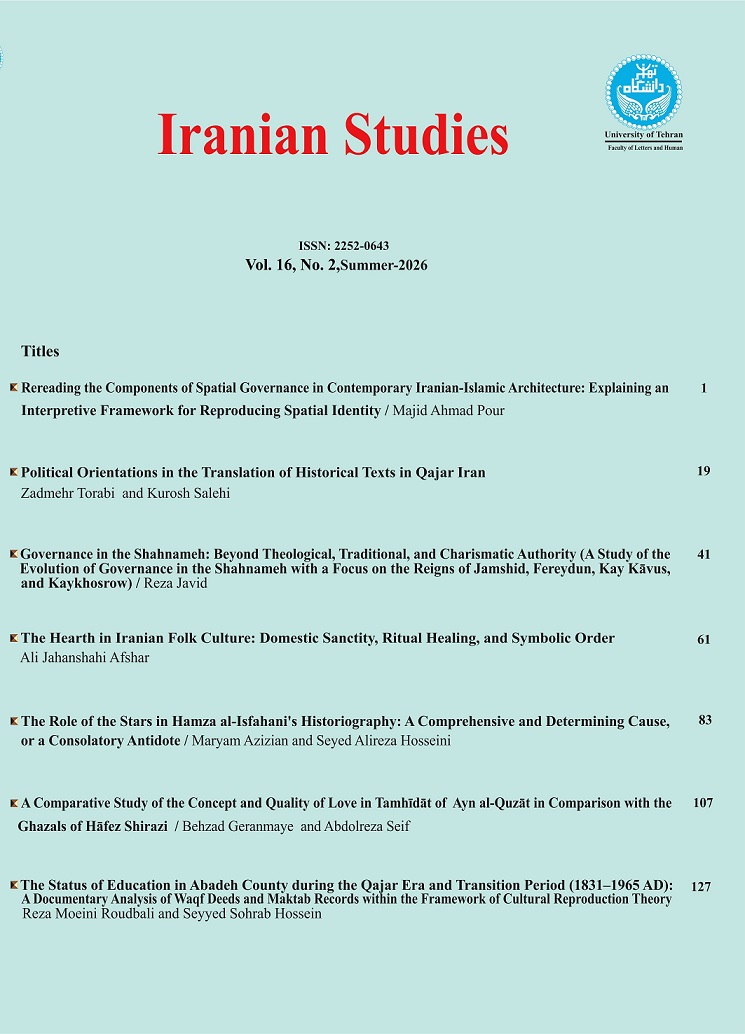
Political Orientations in the Translation of Historical Texts in Qajar Iran

Political Orientations in the Translation of Historical Texts in Qajar Iran

Volume 16, Issue 2, Summer 2026, Pages 19-40

https://doi.org/10.22059/jis.2026.410445.1394

Zadmehr Torabi, Kurosh Salehi

Abstract During the Qajar period, the translation of historical texts into Persian surged in response to pressing societal demands, yet this practice was far from a purely historical exercise. Motivated by a desperate quest to diagnose the roots of Iran’s backwardness and to find a viable path to development, various translations emerged, with historical works drawing substantial interest from courtiers, statesmen, and reformists. Employing a historical methodology, this study critically examines the translation process of these historical texts and analyzes their underlying political orientations. It specifically investigates how political, cultural, and social factors influenced these translations, exploring existing orientations such as selectivity in content, deliberate distortions, and the strategic emphasis on certain themes. The findings indicate that these translations were carried out in a distinctly selective fashion, with their bias predominantly shaped by the imperatives of power and a focused interest in the careers of prominent European rulers. This selective process reveals that most translations were politically charged, often aligned with modern state theory, and fundamentally oriented toward identity-formation. As a result, while they had a relatively modest impact on deepening Iranians’ understanding of their own historical context and identity, they inadvertently set the stage for major intellectual developments in the subsequent era.

Phenomenological representation of national identity among the right-wing society of Iran

Phenomenological representation of national identity among the right-wing society of Iran

Volume 15, Issue 1, Summer 2025, Pages 69-87

https://doi.org/10.22059/jis.2024.367886.1246

sajjad omidoiur, abolfazl delavari

Abstract The Concept of National Identity in Sufi Communities: A Case Study of the Ahl-e Haqq Order in Iran  Today, the concept of national identity constitutes a central issue in the nation-state building project and is a fundamental component of social capital. At the same time, defining the role of Sufi communities within this project remains a contentious subject. A critical and underexplored question is whether national identity and a positive attitude toward Iranian nationhood exist among Sufi adherents—a question that this study addresses, demonstrating that, at least for some groups, the answer is affirmative.  The prevailing assumption is that Sufis are inherently non-national, leaning instead toward cosmopolitanism—or even transcendent universalism. This research challenges such notions by examining the extent of national identity awareness and allegiance among followers of the Ahl-e Haqq Order, one of Iran’s largest Sufi traditions.  Conducted through phenomenological analysis in the counties of Sahneh, Sarpol-e Zahab, and Delfan (in Kermanshah and Lorestan provinces), this study draws on 21 purposively sampled cases from the target population. Findings reveal that the lived experience of Ahl-e Haqq followers is predominantly shaped by tariqa (order-based) identity, which, far from hindering national identity formation, actively facilitates its manifestation in everyday life through various mechanisms