Keywords = قاجار
Number of Articles: 6
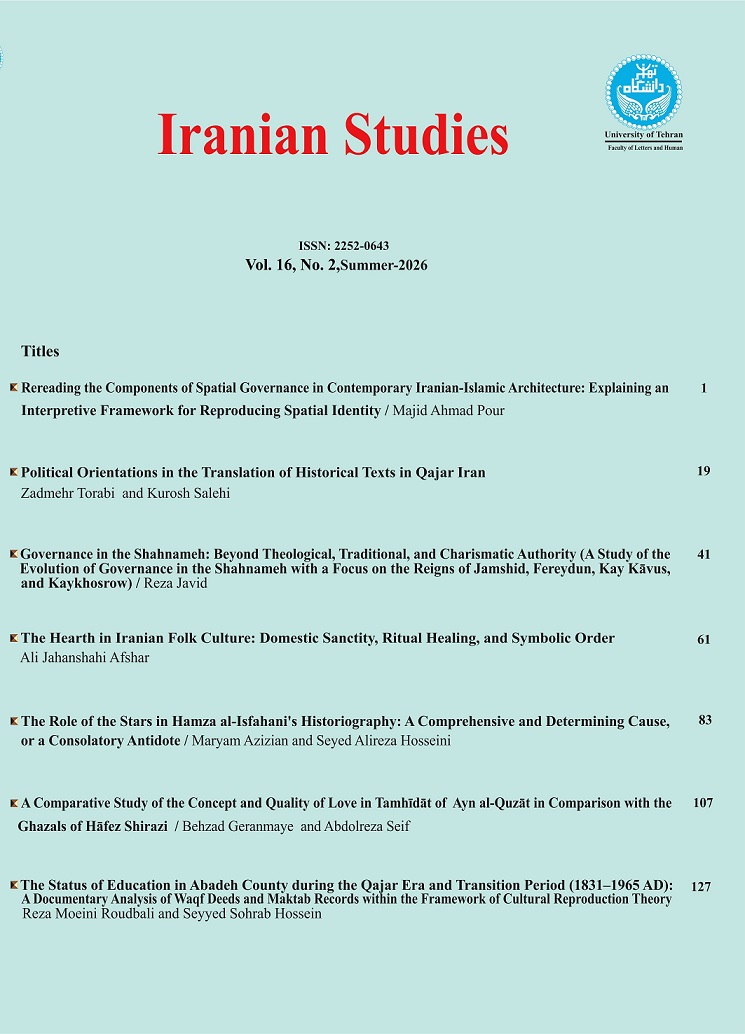
Political Orientations in the Translation of Historical Texts in Qajar Iran

Political Orientations in the Translation of Historical Texts in Qajar Iran

Volume 16, Issue 2, Summer 2026, Pages 19-40

https://doi.org/10.22059/jis.2026.410445.1394

Zadmehr Torabi, Kurosh Salehi

Abstract During the Qajar period, the translation of historical texts into Persian surged in response to pressing societal demands, yet this practice was far from a purely historical exercise. Motivated by a desperate quest to diagnose the roots of Iran’s backwardness and to find a viable path to development, various translations emerged, with historical works drawing substantial interest from courtiers, statesmen, and reformists. Employing a historical methodology, this study critically examines the translation process of these historical texts and analyzes their underlying political orientations. It specifically investigates how political, cultural, and social factors influenced these translations, exploring existing orientations such as selectivity in content, deliberate distortions, and the strategic emphasis on certain themes. The findings indicate that these translations were carried out in a distinctly selective fashion, with their bias predominantly shaped by the imperatives of power and a focused interest in the careers of prominent European rulers. This selective process reveals that most translations were politically charged, often aligned with modern state theory, and fundamentally oriented toward identity-formation. As a result, while they had a relatively modest impact on deepening Iranians’ understanding of their own historical context and identity, they inadvertently set the stage for major intellectual developments in the subsequent era.

The Status of Education in Abadeh County during the Qajar Era and Transition Period (1831–1965 AD): A Documentary Analysis of Waqf Deeds and Maktab Records within the Framework of Cultural Reproduction Theory

The Status of Education in Abadeh County during the Qajar Era and Transition Period (1831–1965 AD): A Documentary Analysis of Waqf Deeds and Maktab Records within the Framework of Cultural Reproduction Theory

Volume 16, Issue 2, Summer 2026, Pages 127-148

https://doi.org/10.22059/jis.2026.412347.1408

Reza Moeini roudbali, Seyed sohrab Hosseini

Abstract Education in Qajar Iran functioned as a dynamic social field for reproducing power relations and social prestige beyond a mere administrative structure. This study explains the organization of local education in Abadeh County (1210–1344 SH / 1831–1965 AD) by analyzing the structured relationship between the institution of Waqf (endowment) and the reproduction of cultural capital. The central research problem is how the local educational system operated without direct central government intervention and how regional elites managed this sphere within the decentralized administrative framework of the “Protected Domains” (Mamalik-i Mahrusah). Using a descriptive-analytical approach combined with a multi-level documentary analysis of 42 archival sources (including endowment deeds, school records, travelogues, and administrative correspondence from NLAI/SAKMA), this study employs Pierre Bourdieu’s “Cultural Reproduction” theory as its interpretive framework. The findings indicate that education in Abadeh functioned as an “autonomous field” grounded in the institutional logic of Waqf. In the absence of a centralized educational bureaucracy, Waqf served as a strategic mechanism for converting the economic capital of local elites into symbolic capital (prestige) and consolidating their socio-religious legitimacy. Furthermore, the transition to modern education in this region was not a sudden rupture, but rather a hybrid process built upon the foundation of traditional networks. The persistent silence of historical documents regarding the lower and marginalized classes also confirms the role of traditional education in reproducing structural inequalities under the guise of religious charity. Ultimately, this study emphasizes the necessity of revising macro-oriented and centralist narratives in the history of education, underscoring the critical role of “indigenous logics” in peripheral regions

Evaluating Mourning Ceremonies of Aristocrats and Ordinary People ‎Based on Travel Writers’ Reports in the Qajar Period

Evaluating Mourning Ceremonies of Aristocrats and Ordinary People ‎Based on Travel Writers’ Reports in the Qajar Period

Volume 13, Issue 4, March 2024, Pages 111-126

https://doi.org/10.22059/jis.2022.343207.1124

Abbas Mirzaei, Ali Balvardi

Abstract Mourning ceremonies related to Muharram have had a special place in the Qajar period, but the views of the Qajar aristocracy and nobility with ordinary people about these ceremonies cannot be considered the same. These two classes have had different traditions in holding mourning ceremonies. In this article, this issue was studied based on the reports written by the foreign travel writers of the Qajar period and it was tried to answer the question of what differences there have been between the mourning traditions of the Qajar aristocracy and nobility and ordinary people based on these travelogues. This hypothesis was followed that the aristocracy and nobility probably held mourning traditions at a different level from that of ordinary people in terms of rituals, luxuries, and expenses because of having greater access to wealth resources. Hence, by examining 22 travelogues, which were based on the travel writers’ objective observations, it was concluded that the aristocracy and nobility differed from ordinary people in terms of their mourning places and forms, as well as expenses. They followed different rituals and customs when holding these ceremonies.

The formation of Anjoman Eslamiyeh Tabriz (Tabriz Islamic Association) and its function during the Constitutional period (21 Muharram-17 Ramadan 1326 AH/24 Februrary-13 October 1908 A.D)

The formation of Anjoman Eslamiyeh Tabriz (Tabriz Islamic Association) and its function during the Constitutional period (21 Muharram-17 Ramadan 1326 AH/24 Februrary-13 October 1908 A.D)

Volume 13, Issue 2, September 2023, Pages 75-95

https://doi.org/10.22059/jis.2022.350202.1164

Noor al-Din Nemati, Jamal Pirehmard Shotorban

Abstract The constitutional movement was one of the most decisive events in the history of Iran. One of the consequences of constitutionalism was the formation of associations that worked in various ways to support or criticize the constitution. "Anjoman-e Eslamiyeh" of Tabriz was one of these organizations, which in 1326 A.H., with the efforts of a group of Tabriz clerics, including Mir Hashem-e Davachi, was established in the vicinity of the gate of Sorkhab and the alley of Davachi/Shotorban. After the parliament was bombed by the king (Muhammad Ali Shah) the association became a supporter of the government. Despite the importance of the subject, so far no independent article has been written about the Anjoman-e Eslamiyeh, and the present article seeks to fill a part of the existing scientific gap. In addition, by criticizing the dominant view of Iran's constitutional history, the article has tried to adopt a new approach to constitutional critic associations, especially Anjoman-e Eslamiyeh, which is based on the review of sources.
The establishment, continuity and fall of Anjoman-e Eslamiyeh raises the question of how and with what motivation the association was formed and what role did it play in the developments of Tabriz in the midst of the transition period? in this article, an attempt has been made to answer the above question with a descriptive-analytical approach and using the qualitative research method. The hypothesis of the current research is that Anjoman-e Eslamiyeh, which was formed from the religious, political, social and economic motives of the "Founders of Eslamiyeh", at the beginning of the so called "Estebdad-e Saghir" period, became a center of support for the government of MuhammadAli shah in Tabriz, but the conflict of opinions of the founders of Eslamiyeh along with the resistance of the people of Tabriz and their suspicion of the government forces, paved its way to collapse.


Abstract

The constitutional movement was one of the most decisive events in the history of Iran. One of the consequences of constitutionalism was the formation of associations that worked in various ways to support or criticize the constitution. "Anjoman-e Eslamiyeh" of Tabriz was one of these organizations, which in 1326 A.H., with the efforts of a group of Tabriz clerics, including Mir Hashem-e Davachi, was established in the vicinity of the gate of Sorkhab and the alley of Davachi/Shotorban. After the parliament was bombed by the king (Muhammad Ali Shah) the association became a supporter of the government. Despite the importance of the subject, so far no independent article has been written about the Anjoman-e Eslamiyeh, and the present article seeks to fill a part of the existing scientific gap. In addition, by criticizing the dominant view of Iran's constitutional history, the article has tried to adopt a new approach to constitutional critic associations, especially Anjoman-e Eslamiyeh, which is based on the review of sources.

The establishment, continuity and fall of Anjoman-e Eslamiyeh raises the question of how and with what motivation the association was formed and what role did it play in the developments of Tabriz in the midst of the transition period? in this article, an attempt has been made to answer the above question with a descriptive-analytical approach and using the qualitative research method. The hypothesis of the current research is that Anjoman-e Eslamiyeh, which was formed from the religious, political, social and economic motives of the "Founders of Eslamiyeh", at the beginning of the so called "Estebdad-e Saghir" period, became a center of support for the government of MuhammadAli shah in Tabriz, but the conflict of opinions of the founders of Eslamiyeh along with the resistance of the people of Tabriz and their suspicion of the government forces, paved its way to collapse.


Keywords

Constitutionalism, Tabriz, Anjoman-e Eslamiyeh, Mir Hashem-e Davachi, Estebdad-e Saghir.

Introducing the manuscript of Lily Majnoon by Karamali by order of Mirza Mahmoud Khan, the representative of Iran in The Hague during the Qajar period, preserved in England

Introducing the manuscript of Lily Majnoon by Karamali by order of Mirza Mahmoud Khan, the representative of Iran in The Hague during the Qajar period, preserved in England

Volume 12, Issue 2, March 2023, Pages 125-157

https://doi.org/10.22059/jis.2022.342845.1113

الهه Panjehbashi

Abstract Apart from the artistic and historical aspects, paintings are one of the cultural, artistic and literary manifestations in different periods of Iranian art history. The first aspect of the importance of these issues is the connection with the rich Iranian literature and the transmission of literature and cultural and artistic traditions of different periods. The study of these works can be important for their conceptual, symbolic, literary and decorative features and visual features. One of the examples of the connection between Qajar painting and literature is the manuscript that was painted by an artist named Karamali in the Qajar period and no specific information about his life is available. The painting, numbered LOT144 R, sold for 6 6,000 at the 2018 Bonhams Auction in London. This copy was made and customized for Mirza Mahmoud Khan, the representative of Iran in The Hague, the Netherlands. This version has 24 images, 9 of which were sold at auction and its images are available. The purpose of this research is to find out the characteristics of Lily Majnoon version related to the Qajar period, which features are influenced by its period. The question of this research is what visual features does this Qajar version of Lily Majnoon have and what effect does it reflect on the atmosphere of her time in painting? The research method in this research is descriptive-analytical using library resources and reviewing the linear sample of Bonhams auction and the method of analysis is based on the principles and visual rules used in the manuscript and its appearance features. The necessity and importance of research is that this rare Qajar version has not been introduced and studied so far and reflects the cultural and artistic features of the Qajar period in linear painting of this period and shows the necessity of this research.
 

Reflections of Iranian Social Problems in the Documents of the Supreme Court, Beginning of the 14/20 Century

Reflections of Iranian Social Problems in the Documents of the Supreme Court, Beginning of the 14/20 Century

Volume 9, Issue 1, July 2019, Pages 193-213

https://doi.org/10.22059/jis.2019.73437

shahram yousefifar

Abstract Social studies in Iran have focused on today’s situation and, for various reasons, have been ignorant of historical approaches. Since the nineteenth century, due to Iran’s extensive contacts with the West, many social macroeconomic problems have emerged, and some of them have played a crucial role in the production of social structures and social relations, hence the full understanding of today’s major social problems needs the understanding of the complexities and evolution of historical problems up to this day. Such an understanding, however, is difficult to arrive at since identifying and describing the historical issues of each period is heavily influenced by the thinking system of the socio-political power of its time. In this research, a categorization of issues is presented based on a source containing unique data from the challenges and issues of the early twentieth century Iran. The archived documents of the Divan-e Adliyeh Aazam, based on their legal and judicial nature, provide a set of data that will answer the question as to what were the macrosocial issues of Iran in the period under consideration.